Europe’s Wake-Up Call: What If a Coordinated Cyberattack Brought Daily Life to a Halt?
Dr. Abubakr Batheeb.
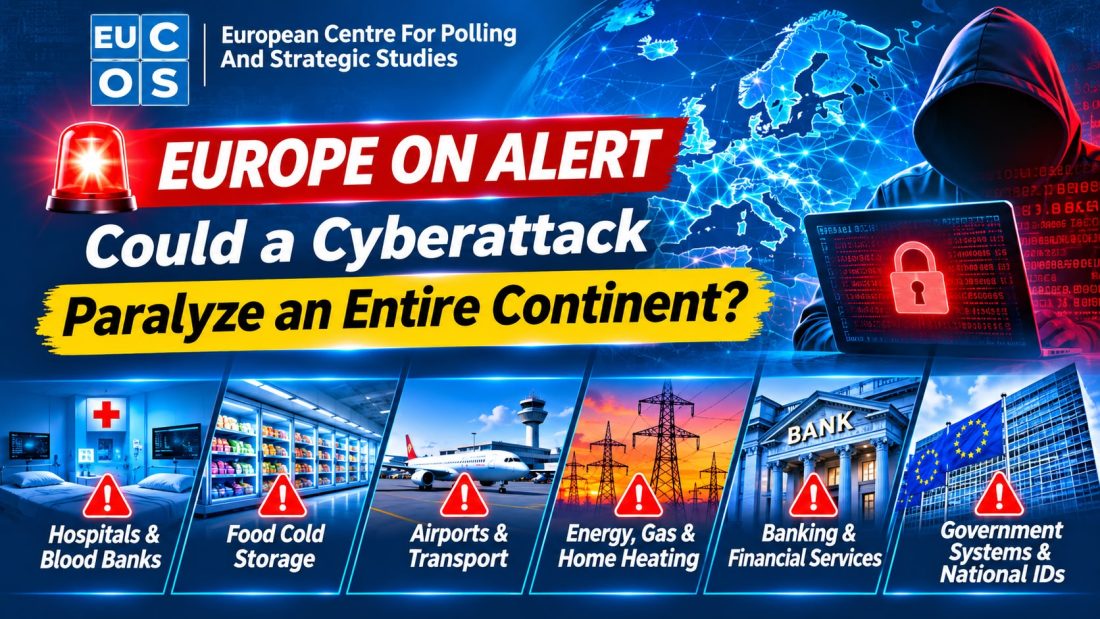
What if Europe woke one morning to an unfamiliar scene: airports at a standstill, trains unable to move, blood-bank and hospital refrigerators out of service, and central food warehouses unable to preserve their supplies? What if governments discovered that email systems, public institutions, government communications networks, databases, and national identification records had been widely compromised? And what if power, gas, fuel, and home-heating systems failed at the same time as bank accounts were breached and financial services disrupted?
This is not the setup for a Hollywood film, nor is it science fiction. These are plausible scenarios that reveal the nature of the threats facing states. As in other advanced societies, everyday life in Europe is now tied to an interconnected digital infrastructure that manages everything from air and rail traffic to healthcare, banking, energy, and communications. A major disruption to this infrastructure could quickly escalate from a technical problem into an economic, social, security, and sovereignty crisis.
In recent months and years, the world has seen cyberattacks targeting government bodies, companies, and critical infrastructure. Europe, too, has experienced acts of sabotage and digital disruption affecting vital sectors.
The more serious question is not whether a limited attack could disrupt a single institution or service, but what might happen if multiple attacks struck interconnected sectors at the same time.
Imagine the attack lasted just six hours. Air traffic could come to a halt and trains could be delayed. Shipping and distribution could be disrupted, and hospitals might lose access to some digital systems. Electronic payments or access to bank accounts could fail, while government agencies struggled to verify records and deliver services. If the disruption spread to electricity, gas, and heating networks, the crisis would move beyond computer screens and directly into people’s homes and daily lives.
The problem is that these sectors do not operate in isolation. They depend on interconnected technical, logistical, and security supply chains. Hospitals need electricity, communications, and supplies. Airports rely on booking, surveillance, and communications systems. Food networks depend on transport, storage, and energy.
Targeting the links between these sectors could therefore magnify the impact of an attack, even if not every institution were directly compromised.
This raises strategic questions: Does Europe have conventional alternatives if digital systems fail? Could airports, railways, and hospitals operate manually or through backup systems? Are secure, independent copies of government databases and banking records available? And could essential services be restored if an attack lasted for days, or recurred soon afterward?
Can this uncertainty be examined with due caution, or is it a matter of sovereignty that cannot be discussed or answered? The issue is not simply preparedness for a single cyberattack, but the ability to manage a complex crisis in which cyberattacks coincide with disinformation, physical sabotage, economic pressure, and perhaps military threats. This is the essence of hybrid warfare: to unsettle a state and weaken its ability to respond, without necessarily engaging in direct military confrontation.
In the European context, tensions with Russia cannot be ignored, nor can cyber capabilities attributed to entities linked to countries such as Russia, China, and Iran, alongside criminal hacking networks and transnational groups. But it is essential to distinguish between documented capabilities and attacks, on the one hand, and the assumption that Russia, China, and Iran would coordinate a unified attack, on the other. The latter remains hypothetical and should not be treated as an established fact.
The claim that European societies are more exposed to cyber threats than Russia or China also requires scrutiny. Widespread reliance on digital services creates vulnerabilities, but it does not automatically mean that protections are absent or resilience is weak. At the same time, no country is entirely immune to intrusion or sabotage, regardless of its technological and security capabilities.
Europe has faced a series of crises that exposed vulnerabilities in some of its systems, from the COVID-19 pandemic to the war between Russia and Ukraine, the energy crisis, supply-chain disruptions, and regional tensions in the Middle East. Each crisis has offered a different lesson about the interdependence of countries, economies, and infrastructure. A large-scale cyberattack could bring these risks together in a single moment, turning them into a real test of a state’s ability to keep functioning.
Europe needs more than improved cyber defenses. It needs a comprehensive national and European resilience framework: independent backup networks, offline copies of critical data, manual operating plans for essential facilities, emergency reserves of energy, fuel, medical supplies, and food, joint exercises involving governments and the private sector, and clear mechanisms for informing the public and managing a crisis.
This also requires stronger intelligence and security cooperation, as well as clear legal and operational responsibilities in the event of a large-scale attack—without the habitual hesitation and surprise that seem to follow every attack, wherever it occurs.
The real warning is not that an airport, bank, or power station might be shut down for a few hours. It is that several systems could fail at once, leaving a state without a rapid way to restore its essential functions.
Europe does not need to wait for a major cyberwar to test its resilience. It should treat this possibility as part of its national security, not merely as a technical matter for specialist agencies. The strength of a modern state is measured not only by how advanced its digital systems are, but also by its ability to keep life going when those systems stop working.
The question that should concern European capitals is not, “Could we be hit by a cyberattack?” It is: “If an attack happened tomorrow morning, for how many hours could Europe keep functioning before a digital crisis became a widespread shutdown?” We live on this continent, and questions about its security and stability are part of our daily lives.